

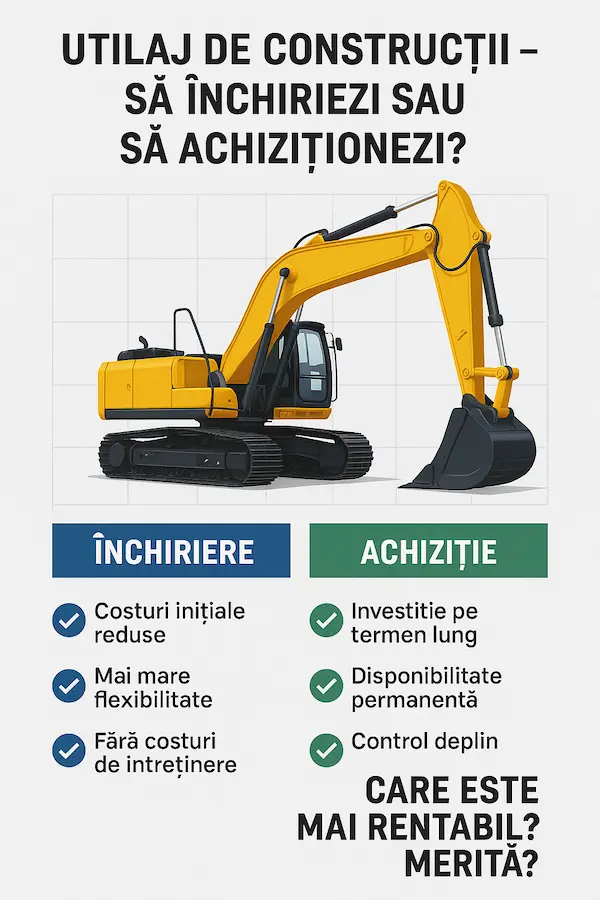
Any construction company, small or large, is faced with a difficult decision at some point: to purchase their own equipment or to rent them when projects appear?
Whether we are talking about a mini excavator for rent, a telescopic boom, a backhoe or a compactor, investing in a new machine can mean tens or even hundreds of thousands of euros. On the other hand, renting seems simpler — but is it really profitable in the long run?
In this article we compare the two options: purchase vs rental, to help you choose what best suits your needs.
🔸 1. Initial costs: purchase vs. rental
🔹 Acquisition – large investment, but with total control
Buying a construction machine involves a significant initial investment.
- A new mini excavator can cost between €25,000 and €50,000,
- o articulated boom between €30,000 and €70,000,
- and one fully equipped backhoe loader can exceed 80.000 €.
In the long term, owning the equipment gives you complete freedom: you can use it whenever you want, without rental fees. However, the amortization takes place over a few years, and until then you also have to bear the costs of maintenance, storage and overhauls.
🔹 Renting – minimum investment, maximum flexibility
By comparison, renting a construction machine involves low and flexible costs.
You can have a mini excavator for rent for €80–120/day or rental platform for €100–150/day, without investing thousands of euros.
It is ideal for:
- small or start-up companies,
- occasional or seasonal work,
- entrepreneurs who don't want to lock up capital in equipment.
🔸 2. Hidden costs and maintenance
🔹 If you purchase the machine
Owning a machine also means constant expenses:
- periodic inspections, spare parts, consumables;
- transportation costs between construction sites;
- storage space;
- insurance and taxes.
On average, annual maintenance can reach 5–10% of the value of the machine. If you have multiple machines, these amounts add up quickly.
🔹 If you rent the equipment
Renting saves you from these worries.
The rental company takes care of maintenance, technical checks and delivery. In case of a defect, you receive a replacement machine. Basically, you only pay for the period actually used, with no hidden costs.
🔸 3. Effective use of the machine
An essential criterion in the decision is frequency of use.
- If you use the machine daily or almost constantly (e.g. you have large and ongoing contracts), acquisition becomes more profitable.
- If you work project by project, with periods of rest in between, lease is clearly more advantageous.
A mini excavator that sits unused for 6 months a year represents blocked capital, but also money lost in maintenance and depreciation.
🔸 4. Operational flexibility
🔹 Renting offers freedom and adaptability
When you rent, you can choose exactly the right type of machine for each job.
Today you need a telescopic boom, tomorrow at one mini excavator or a compactor — all are available without investing in each separately.
This flexibility is ideal for companies that work in diverse fields or have projects of different sizes.
🔹 Ownership provides control, but limits adaptability
If you buy a machine, you are „tied” to it. It may be perfect for one type of work, but ineffective in others. Plus, when projects come up that require other equipment, you have to rent it additionally, so you pay anyway.
🔸 5. Long-term profitability
🔹 The purchase becomes profitable only after 3–5 years
On average, a machine amortizes its cost after 3–5 years of constant use.
If you have stable projects and a large volume of work during this period, the investment is worth it.
However, if the market fluctuates or you have dead periods, fixed costs can be difficult to sustain. In addition, the value of the machine decreases by 10–15% annually, and new models are constantly emerging.
🔹 Renting is profitable due to the lack of risk
Even though the cost per day is apparently higher, you have no depreciation risks, do not block capital, and you have no service costs.
Additionally, you can include rental costs directly in the job quote, so the end client covers part of them.
🔸 6. Practical situations – when to rent and when to buy
✅ When is it worth renting:
- Are you a small or start-up company?.
- You have short, seasonal or occasional projects.
- You don't want to lock up capital in machinery.
- You need different equipment for each job.
- You don't have storage space or maintenance staff.
✅ When is it worth buying:
- You have long-term, recurring contracts.
- You use the machine almost daily.
- You have your own technical team and storage space.
- You can negotiate the purchase through advantageous leasing.
🔸 7. Examples of indicative costs (comparative)
| Machine type | Purchase cost (€) | Rental cost/day (€) | Break-even point |
|---|---|---|---|
| Mini excavator | 30.000 € | €100/day | ~300 working days |
| Articulated boom | 40.000 € | €130/day | ~300-350 days |
| Compactor | 15.000 € | €70/day | ~215 days |
| backhoe | 80.000 € | €180/day | ~445 days |
🔸8. Additional benefits of renting
Besides the financial aspects, renting comes with other advantages that are hard to ignore:
- You have access to modern and efficient equipment, without investing in upgrades.
- In case of damage, you receive a quick replacement.
- You don't deal with logistics, transportation and technical documentation.
- You can test several models before making a purchase.
🔸 9. Conclusion – is it worth renting or buying?
The answer depends on the size of your business, workload and long-term plans.
- If you have constant projects, your own team and a stable budget, acquisition it can be a profitable investment.
- If you have variable activity, prefer flexibility and want predictable costs, construction equipment rental it is the logical solution.
For most small and medium-sized businesses, renting remains the most efficient and cost-effective option — especially since it offers freedom to adapt to each project, without risks and without huge investments.
🔹 Final tips from specialists
- Calculate the number of days/year you will actually use the machine.
- Consider all the "invisible" costs: transportation, storage, repairs.
- If you're just starting out, start with hire — you can buy later, when you know exactly which machines you use most often.
- Choose serious rental companies that offer new, maintained equipment and complete technical support.