

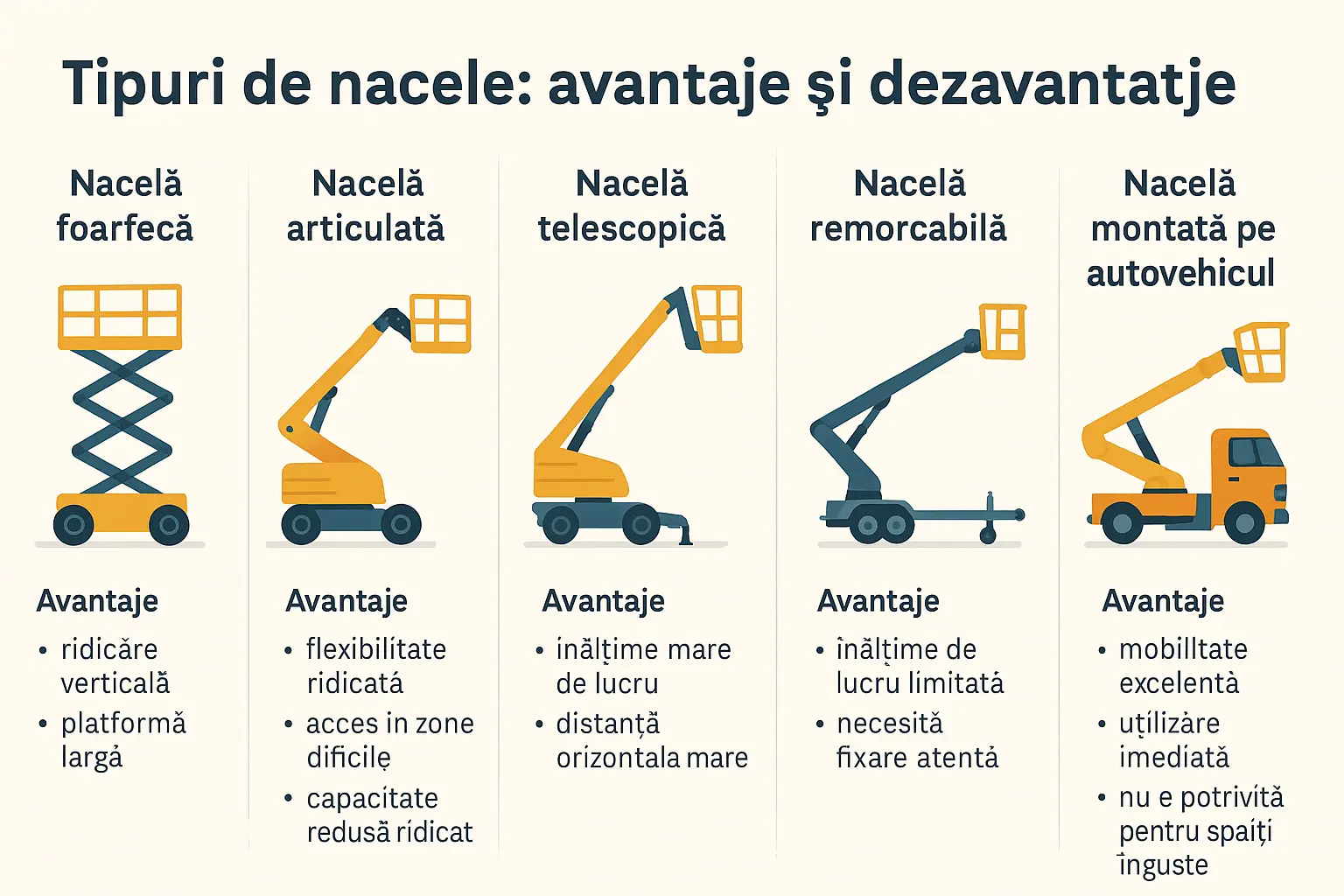
Working at height is an essential part of construction, maintenance, logistics and even advertising. To carry it out safely and efficiently, baskets represents one of the most modern and secure access solutions.
Whether we are talking about installing solar panels, facade work, industrial installations or maintaining green spaces, renting a suitable aerial platform it can make the difference between a quick project and an expensive or risky one.
In this article, we analyze the most important types of nacelles available on the market and we explain to you the advantages and disadvantages of each, to help you choose correctly according to your needs.
🔸 1. Scissor lift
🔹 Description
The scissor lift is probably the most well-known and used in industrial or commercial spaces.
The platform rises. vertical, through a system of pistons arranged in an "X" shape (scissors). It does not extend laterally, which makes it stable, but limited in mobility.
🔹 Advantages
-
UP fast and safe vertical;
-
Platform RANGE, ideal for teamwork;
-
High load capacity (sometimes over 500 kg);
-
Ideal for interior work – halls, warehouses, shopping centers;
-
Low rental cost compared to other models.
🔹 Disadvantages
-
Cannot expand laterally, so access to points outside the vertical axis is limited;
-
Requires flat surface for stability;
-
Not recommended for rough terrain.
🔹 Usage examples
-
Installation of false ceilings or lighting fixtures;
-
Maintenance work in halls;
-
Industrial cleaning at height;
-
Installation of interior metal structures.
🔸 2. Articulated boom
🔹 Description
Articulated booms have movable arms, made up of several segments connected by joints.
They can be powered electrically (for indoors) or diesel (for outdoors) and offer flexibility of movement in narrow spaces.
🔹 Advantages
-
Maybe access hard-to-reach areas thanks to the flexible arm;
-
Movement in vertical and horizontal planes;
-
Can avoid obstacles – very useful for facade work;
-
Excellent stability and control;
-
Available in compact indoor versions.
🔹 Disadvantages
-
Higher rental cost than a scissor lift;
-
Lower load capacity (100–250 kg);
-
Requires trained operator (more complex handling).
🔹 Usage examples
-
Facade and window repairs;
-
Installation of banners or advertising boards;
-
Exterior painting and cleaning works;
-
Maintenance of electrical installations at height.
🔸 3. Telescopic nacelle (telescopic boom)
🔹 Description
Telescopic boom lifts are powerful equipment used for working at high heights and extended distances.
Their arm extends linear, like a telescope, and can even reach over 40 meters in height.
🔹 Advantages
-
The biggest working height of all types;
-
Large horizontal distance – ideal for large construction sites;
-
High stability, including on rough terrain (diesel models);
-
It can lift people and heavy tools.
🔹 Disadvantages
-
Reduced maneuverability in narrow spaces;
-
Higher cost of purchase and rental;
-
It is not ideal for interior work.
🔹 Usage examples
-
Industrial and civil construction;
-
Installation of metal structures and roofs;
-
Maintenance work on high-rise buildings;
-
Installations on uneven terrain.
🔸 4. Trailer lift
🔹 Description
This type of platform is mounted on a trailer and can be easily transported with a vehicle.
It is ideal for short-term work or for companies that need mobility between multiple locations.
🔹 Advantages
-
Easy and fast transportation;
-
Can be used immediately, without a truck or platform;
-
Versatile – suitable for small and medium jobs;
-
Lower rental costs.
🔹 Disadvantages
-
Limited working height (10–20 meters);
-
Less stability on rough terrain;
-
Requires careful fixation before use.
🔹 Usage examples
-
Maintenance of green spaces and tree pruning;
-
Advertising installation and street lighting;
-
Repair work on residential buildings.
🔸 5. Truck-mounted lift
🔹 Description
This is a platform fixed to a truck or van. It is used for quick interventions and works that require frequent travel between locations.
🔹 Advantages
-
Excellent mobility – can move immediately from one place to another;
-
Can be used directly from the road;
-
High working height (10–30 meters);
-
No additional transportation required.
🔹 Disadvantages
-
Higher rental cost;
-
Requires space for parking and stabilization;
-
It is not suitable for indoor or confined spaces.
🔹 Usage examples
-
Repairs and installation of lighting poles;
-
Roofing work, solar panels, banners;
-
Rapid interventions in urban areas.
🔸 6. Spider nacelle (tracked)
🔹 Description
It is a versatile, compact and capable of working on rough terrain, called "spider" because of the stabilizer arms. It can be electric or diesel, ideal for hard-to-reach spaces.
🔹 Advantages
-
Compact, fits through narrow doorways;
-
Stable on uneven terrain;
-
Suitable for indoors and outdoors;
-
Medium working height (10–25 m).
🔹 Disadvantages
-
Low travel speed;
-
Higher purchase and rental cost;
-
Requires careful mounting of stabilizers.
🔹 Usage examples
-
Works in courtyards, churches, green spaces;
-
Maintenance of historic buildings;
-
Interventions in hard-to-reach spaces.
🔹 Conclusion – how do you choose the right nacelle?
Choosing the right platform depends on:
-
Type of work (indoor/outdoor);
-
Required height;
-
Access to the work area;
-
Project duration;
-
Available budget.
👉 For interior work – scissor lifts or electric articulated are ideal.
👉 For outdoors or high altitudes – telescopic boom lifts, car or with tracks offers performance and safety.
👉 For maximum mobility – towable boom lifts they are the practical and economical choice.
🔸 Final recommendation
If you only need a boom lift occasionally, renting is the most cost-effective solution.
Thus, you benefit from:
-
modern, technically verified equipment;
-
controlled costs;
-
professional assistance;
-
and without large investments in maintenance.
A company specializing in construction equipment rental can provide you with free advice on choosing the right aerial platform and deliver the equipment directly to your construction site.